Gebrüder Weiss automates email-driven freight operations with Levity, cutting manual work in half while strengthening customer service
The Challenge
Gebrüder Weiss’s FTL team was growing fast, but email-driven workflows couldn’t keep up.
- Quote latency: Operators toggled across multiple pricing tools to manually build and send quotes, turning a seconds-long task into an hours-long one.
- Operational drag: Order entry, document follow-ups, and carrier coordination all required manual handoffs, leaving nearly 40% of daily work with no automation.
The Solution
Gebrüder Weiss partnered with Levity to automate the repetitive 40% directly inside Outlook, where every customer interaction already lived. Targeted workflows for quoting, order entry, invoice follow-ups, and carrier tagging integrated with Turvo, Triumph, and Greenscreens, while operators kept full control of every customer relationship.
- Headcount
- 8,600+
- Revenue
- $3.17 B
Gebrüder Weiss is one of the world’s oldest and most respected transport and logistics companies, a family-owned organization with more than 500 years of history, 8,600 employees, and 180 locations across 34 countries. The company has been expanding in North America since establishing its U.S. headquarters in Chicago in 2017, with its full truckload (FTL) brokerage growing rapidly under the leadership of Kevin Sendre, Director of FTL North America.
Gebrüder Weiss runs on a principle of personalized service: a single point of contact, deep customer relationships, and operators who know their customers’ freight as well as their own business. As the FTL operation scaled, the challenge was clear: how do you handle growing volume without losing the human touch that defines the company?
Email-driven workflows consume operator time
The Gebrüder Weiss FTL team relied on email for virtually every operational task: quoting, order entry, carrier coordination, and document follow-ups. Each process required manual handoffs between inboxes and multiple systems, with operators toggling across three or four screens to complete a single quote or build a single load.
It was a very mundane, slow process,
said Sendre. Customers don’t want to wait six hours, four hours, or even thirty minutes sometimes. That speed to quote matters.
The quoting bottleneck was the most visible pain point: operators manually extracting shipment details from emails, entering them into external pricing tools like Triumph and Greenscreens, then drafting responses back. But the manual burden extended across the entire operation: order entry required keystroke-by-keystroke load building in Turvo, and the billing team had to manually chase carriers for proof-of-delivery documents and invoices every single day. Nearly 40% of the team’s daily activities were still manually driven, time that could have been spent on exceptions, customer relationships, and revenue-generating work.
We’re not trying to replace our people. We’re giving them better tools so they can spend less time on manual work and more time on revenue-generating activities and customer service.
Automating where the work already happens
Gebrüder Weiss’s requirements were specific: automation had to work directly from Outlook, where every customer interaction already lived, integrate with existing systems, and roll out incrementally so the team could build trust before depending on it. Most importantly, it had to preserve operator judgment and customer ownership, rather than bypass them.
Levity built a series of targeted workflows, each eliminating a specific bottleneck:
-
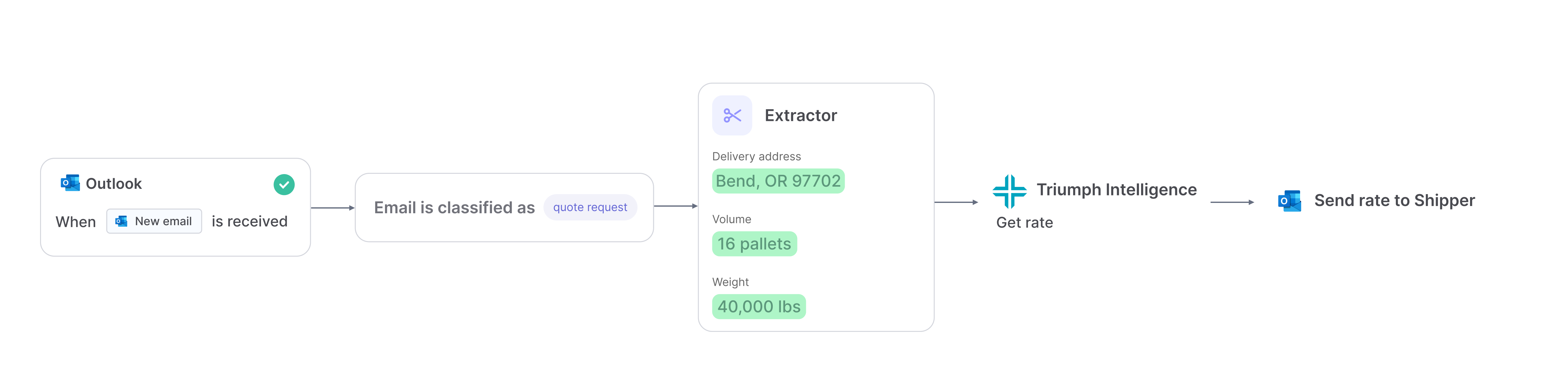
Quoting automation (Email → Triumph / Greenscreens). Inbound quote requests are scraped automatically from email, routed through Gebrüder Weiss’s pricing tools via API, and returned as draft quotes in Outlook. Operators review, adjust, or auto-send depending on the customer relationship. Control never leaves the desk.
-
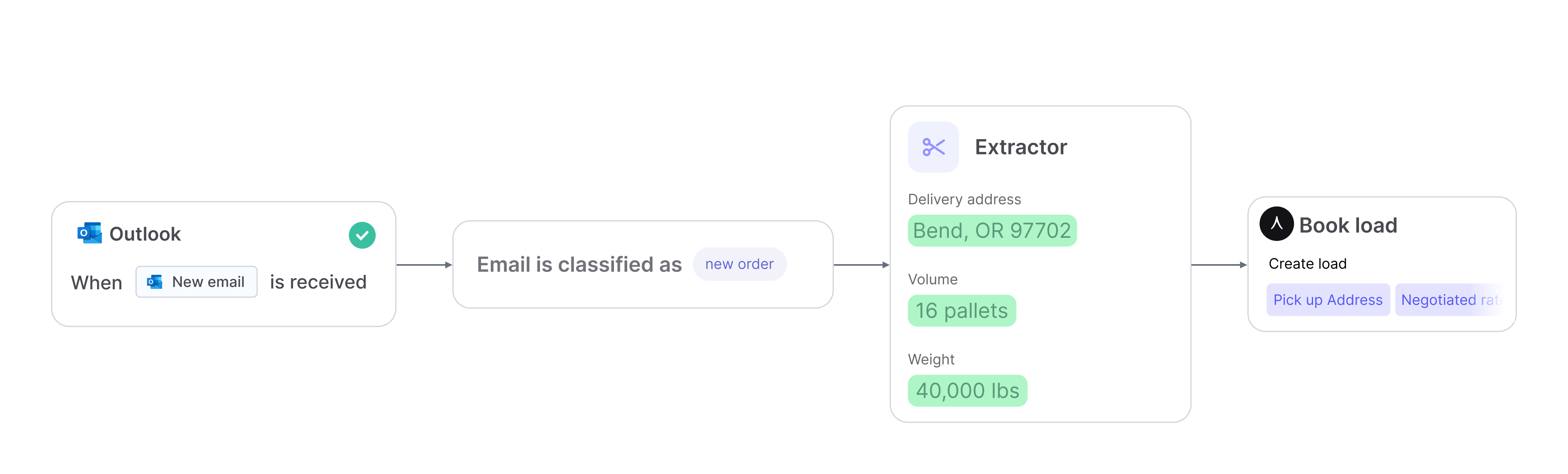
Batch and email-based order entry (Excel / Email → Turvo). Contract customers sending hundred-shipment spreadsheets now have loads built automatically in under a minute, each with unique reference numbers and full shipment details. The batch workflow saves roughly 2 hours per week. For one-off orders, operators simply forward a customer’s email and the system creates the load directly.
-
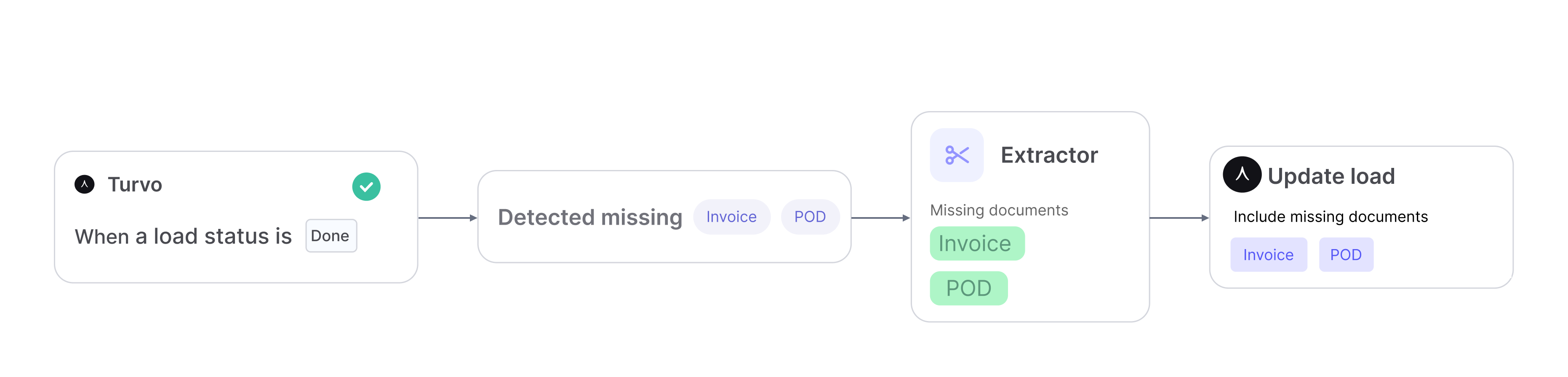
Invoice and POD follow-ups (Status changes → automated outreach). The system monitors delivery statuses in Turvo and automatically triggers document requests to carriers, tracks responses, and sends follow-ups on a defined cadence. This single workflow saves roughly 2 hours of manual work every day. The weekly chase is gone entirely.
-
Automated tagging (Email / Macropoint / Turvo). Carrier tracking updates and status changes are automatically tagged and processed, saving 30 minutes per execution cycle.

Emails are being scraped behind the scenes all the time,
Sendre said, and we’re able to provide those quotes at a significantly faster pace than having to jump around from screen to screen.
Critically, the outputs are reliable. In an industry where a wrong reference number or a misrouted load has real consequences, consistency isn’t a nice-to-have. The Gebrüder Weiss FTL team needed automation they could trust to perform at a human level or above, every time, without the output variability that plagues many AI tools. The workflows Levity built deliver the same accuracy whether they’re processing the first quote of the day or the hundredth.
What we have found is that partners like Levity enable us to provide a more personalized service to our customers, as Levity handles the high-volume, lower-value work in the background and helps our operators execute flawlessly.
From skepticism to “What else can we automate?”
The rollout started with quoting, and the results converted the team faster than any pitch could have. Quotes that had taken multiple steps and several minutes were generated in seconds. Operators experienced the shift firsthand: a draft appearing in Outlook, ready to send, while they were working on something else.
Sendre compares the adoption curve to the early days of ChatGPT: interesting in theory, indispensable once you use it. They’re able to do ten times what they would do without having the technology,
he said. As each workflow proved itself, demand for automation came from within the team rather than from above. Nobody lost their job. Nobody’s customer relationships were handed to a bot. People simply started doing more of the high-value work they were hired to do.
I was pleasantly surprised at how quickly and easily the automation was adopted internally,
said McCullough. It’s taking the stress and the anxiety out of the system and enabling the team to focus on the bigger picture: service excellence.
The shift wasn’t just about adoption. It was about trust in the output. Sendre’s team had seen enough AI tools that produced inconsistent or unreliable results. What made the difference with Levity’s workflows was that the automation performed dependably, day after day, across thousands of transactions. That reliability is what turned early adopters into advocates, and advocates into the internal champions now pushing automation into new departments.
We’re always trying to automate operational tasks without sacrificing customer service expectations. In fact, I think it’s enhancing those expectations because we can have these tasks run in the background
Measurable impact across FTL operations
The numbers compound across every workflow:
- 40% → 20% — Manually driven activities cut in half, with a path to reducing another 10–15 percentage points over the next two years
- ~2 hours saved per day on invoice and POD follow-ups, fully eliminating the manual document chase
- ~2 hours saved per week on batch order entry, with hundreds of shipments processed in under a minute
- 30 minutes saved per execution on automated carrier tagging workflows
- Quote response times compressed from hours to seconds, directly improving win rate on spot freight
Through one of the toughest freight markets in recent memory, Gebrüder Weiss North America’s FTL brokerage has continued to grow. We have no signs of slowing down,
said Sendre. I think a lot of it is because of the technology partners that have supported our growth throughout this process.
Automation earns its way across the organization
The trust built in FTL is now carrying automation to other services. Gebrüder Weiss has begun testing email sorting and routing for its Air & Sea division, with projected savings of 45 minutes per day per branch, roughly 220 hours per month across all offices. It’s the first use case to cross departmental lines, driven not by mandate but by visible results. Additional FTL workflows are also in the pipeline, including automated document submission that will eliminate manual lookups and uploads in Turvo.
As we build the guidelines on how to deploy AI going forward,
said McCullough, the baseline is very simple. It’s always the customer and the staff first. If we can improve the human experience through automation, which we’ve already proven that we can do, then we will continue to do that.
Sendre’s advice to the industry is direct: If you’re still trying to figure out an AI strategy instead of actually acting on it, you’re behind the eight-ball a little bit.
Gebrüder Weiss started with one workflow that was live in weeks, not months. The first results were immediate. Two years later, the North American FTL operation is twice as efficient, the automation runs reliably across thousands of daily transactions, the team focuses on high-value work, and other departments are following the established model.
More customers
All customers
Experience Levity in action
Explore how large logistics teams move from visibility to reliable automation — all in one platform.