Don't Start With AI Agents. Start With an Enterprise-Owned Governance Layer.
Most logistics companies can run an AI pilot in one country, one inbox, or one narrow process. The hard part starts when the same automation needs to work across dozens of countries, hundreds of customers, multiple systems, local SOPs, and thousands of operational exceptions.
That is why enterprise AI should not start with autonomous agents learning the business as they go. It should start with a governed control layer that makes the business logic explicit.
The question is not just whether AI can create a shipment, classify an email, extract a document field, or draft a reply. The harder question is: who controls what the AI is allowed to do, and how does that control scale across global operations?
The risk of black-box automation
AI vendors create risk when they own both the automation machinery and the business logic. SOPs can become hidden inside vendor workflows. Local exceptions become implementation tickets. IT teams struggle to audit why a process behaved a certain way. Business teams lose visibility into which rule, approval, or threshold caused an action.
That is not a vendor problem as much as a maturity problem. A logistics company should never have to ask a vendor, "Why did our shipment creation process behave this way?" The answer should be visible in the company's own SOPs, rules, approvals, and audit history.
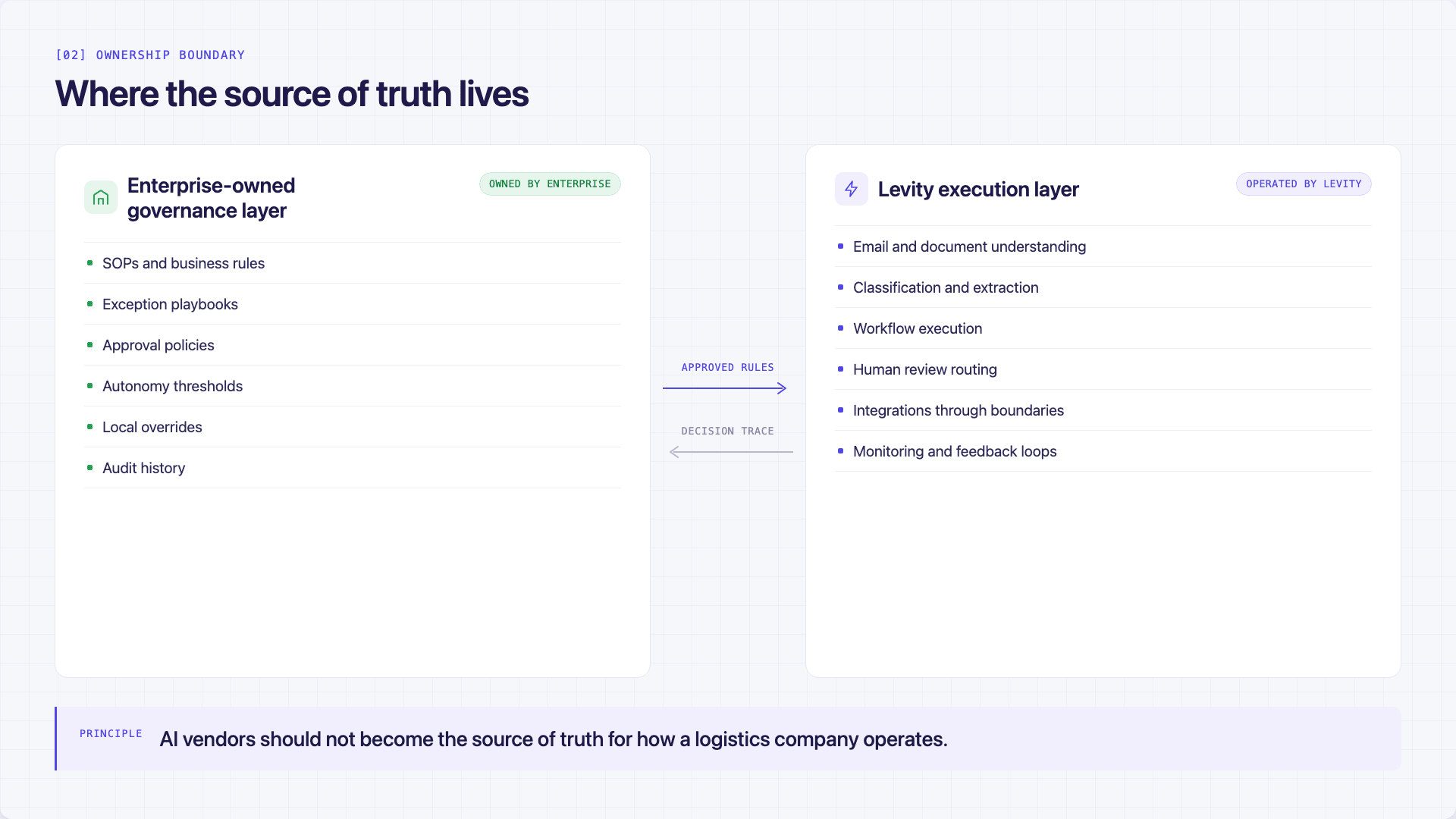
AI vendors should not become the source of truth for how a logistics company operates.
Separate business control from execution
The better model is a clear ownership boundary.
The enterprise owns the "what should happen": SOPs, business rules, exception playbooks, approval policies, autonomy thresholds, local overrides, release approvals, and audit trails.
The automation layer provides the machinery to execute against that logic: email and document understanding, classification, entity extraction, workflow execution, human review, integrations, monitoring, feedback loops, and rollout support.
This matters because enterprise logistics operations are not just a pile of random exceptions. Many exceptions are predictable. They have known recovery paths, known escalation logic, and known approval requirements. The problem is that this judgment often lives across PDFs, local training, shared inbox habits, spreadsheets, and people's heads.
An enterprise-owned governance layer makes that operational judgment explicit, testable, and executable.
Shipment creation is a governance problem
Shipment creation is a good example because it is deeply SOP-driven. A global logistics company may want one standard process for creating shipments, but every rollout still has to respect country rules, office practices, customer requirements, and system boundaries.
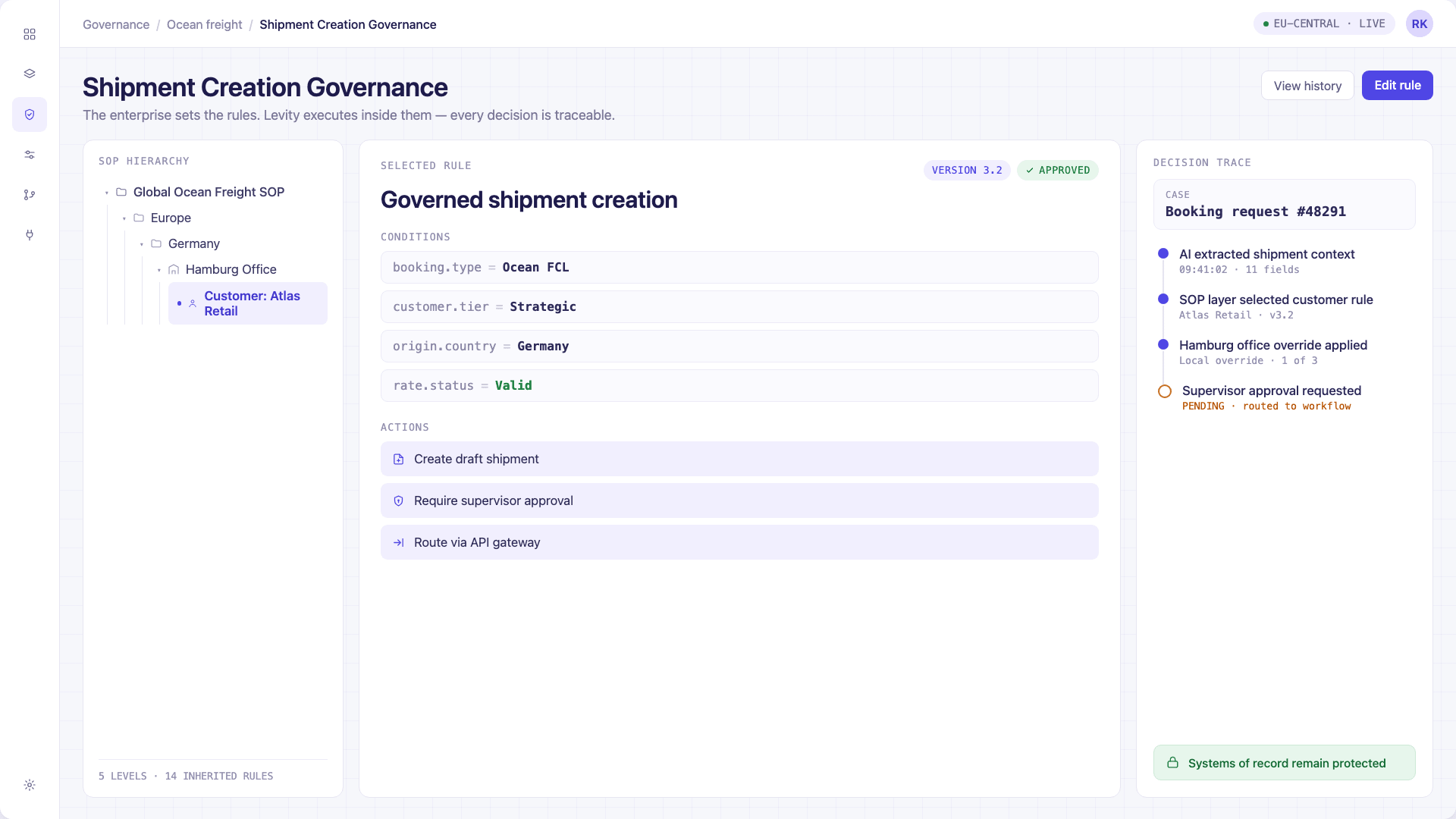
A customer sends a shipment request by email. AI extracts the shipment context: parties, route, mode, dates, documents, references, and any missing information. Before anything is confirmed or written back to a system, the governance layer evaluates the applicable SOP:
- Which global process applies?
- Does the destination country require extra validation?
- Does the local office require supervisor approval?
- Does this customer use a custom reference format?
- Is the rate valid?
- Is human approval required before confirmation?
The AI does not invent the operating model. It executes the recovery path and approval policy defined by the enterprise.
What an AI SOP governance layer does
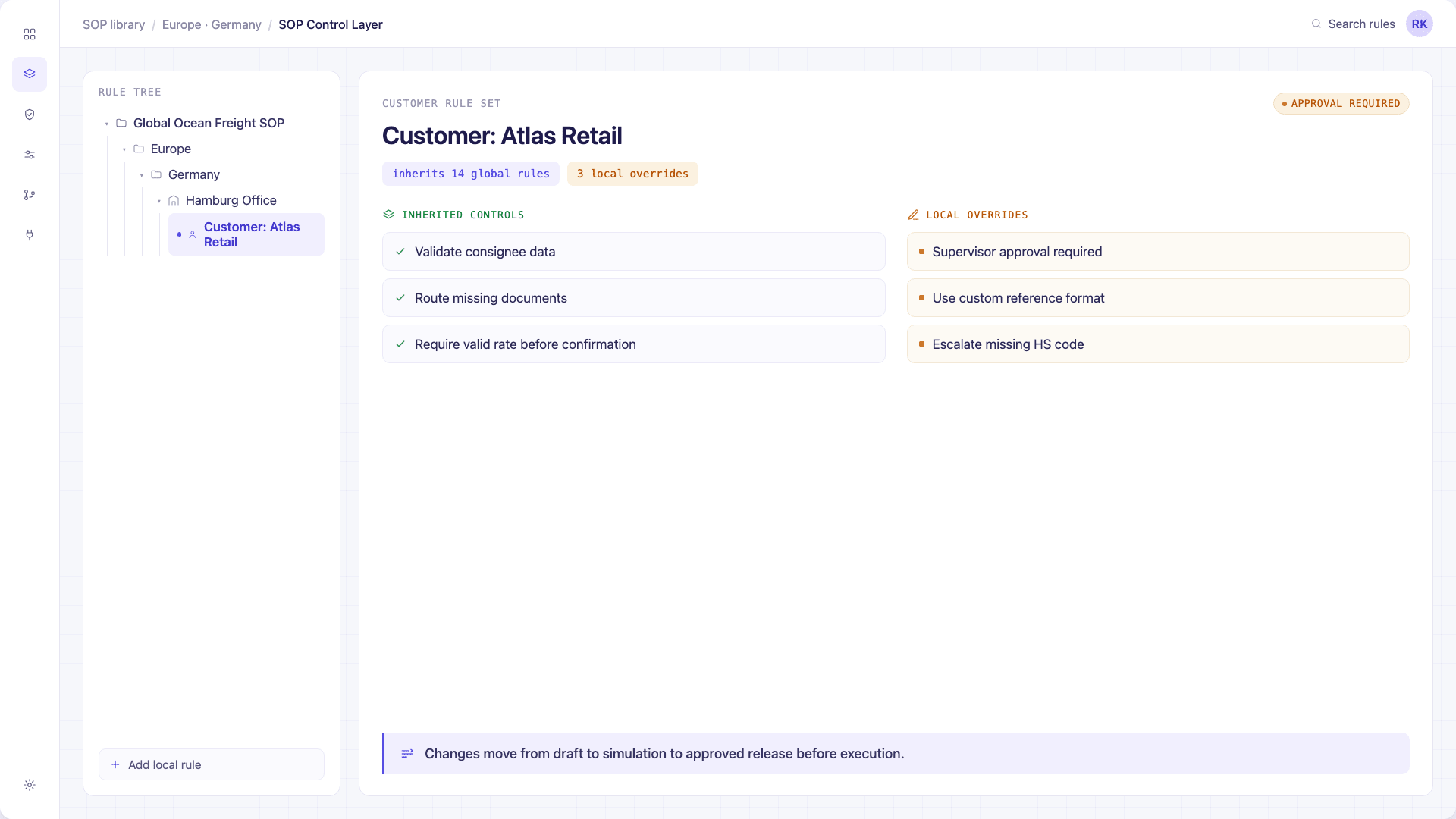
An AI SOP governance layer is where a logistics company defines, tests, approves, and audits the rules AI follows during operational execution.
In practice, that can include visual rule management, a global-to-local hierarchy, exception playbooks, approval workflows, version control, decision tracing, controlled publishing, autonomy settings, and integration boundaries. It resembles modern business rule management, adapted for AI-driven logistics operations.
The important point is not that every company uses the same implementation. Some enterprises may want a customer-hosted or customer-owned rule layer. Others may want Levity to operate execution while IT controls the integration fabric. The architecture can vary. The ownership principle should not.
Business logic should remain portable, visible, and auditable.
Simulate before autonomy
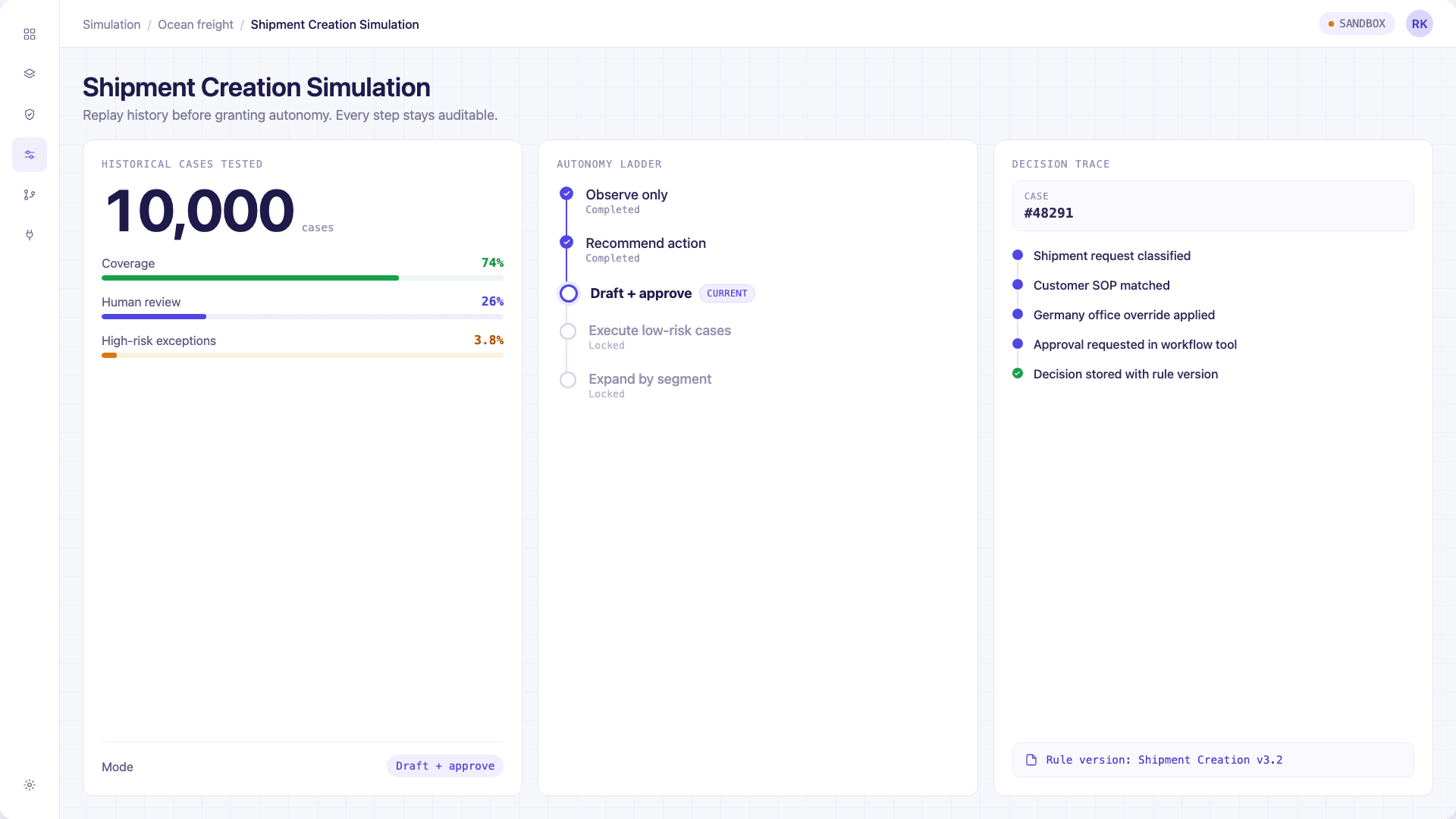
Enterprise AI should not jump from pilot to full autonomy. It should move through stages: observe, recommend, draft for human approval, execute low-risk cases, then expand autonomy by lane, customer, country, office, or process.
Before publishing a shipment creation SOP, teams should be able to simulate it against historical cases. How many cases would the rule cover? How many would still require human review? Which offices create the most exceptions? Which customers are safe to automate first? Where do rules conflict? What is the expected time saving, and where would an error have serious operational impact?
Simulation turns AI rollout into an evidence-based release process instead of a leap of faith.
Protect systems of record
AI agents should not have unrestricted access to systems of record. They should operate through approved interfaces, middleware, permission boundaries, and human approval where required.
In this model, AI reads messy operational communication, structures the context, evaluates the enterprise-owned governance layer, prepares the right action, and routes it through approved channels. The TMS, workflow tools, email systems, middleware, and data warehouse remain protected by the customer's IT and access policies.
For every automated or recommended action, the customer should be able to point to the rule version, approval, input context, decision trace, and outcome.
Where Levity fits
Levity does not need to own a logistics company's operating model. Levity helps execute that operating model at scale.
That means understanding emails and documents, extracting structured shipment data, classifying requests, detecting missing context, matching customer and lane information, drafting responses, routing work, integrating with approved systems, monitoring outcomes, and learning from human corrections.
The enterprise owns the rules. Levity makes them operational.
The next generation of logistics automation will not be built around black-box AI agents making isolated decisions. It will be built around governed systems where SOPs, rules, exceptions, approvals, and autonomy thresholds are explicit, testable, and owned by the enterprise.
AI should not replace operational control. It should make operational control executable.
Continue reading
All posts


Experience Levity in action
Explore how large logistics teams move from visibility to reliable automation — all in one platform.