Your Operations Are Drowning in Feedback. That's a Good Thing.
The emails, chats, and calls behind every shipment are your richest real-time data on where operations break. Here is how to turn that flood into signal instead of noise.

When your logistics operation is growing fast, success feels like a flood. A flood of orders, a flood of shipments, and a flood of communication. Your teams are buried in emails, chat messages, and calls from customers, carriers, and internal stakeholders. It’s a constant stream of feedback, questions, and one-off requests: “Why was this invoice wrong?” “The portal is confusing here.” “Can you add the PO number to this report?”
Most leaders treat this flood as noise. A distraction from the core work of moving freight. They see it as a cost center, a problem to be minimized or deflected.
Here is the contrarian truth: this flood of feedback is the most valuable, real-time data you have about your operational gaps. The problem isn’t the feedback itself. It’s that you have no system to listen to it, structure it, and turn it into fuel for improvement.
The System of Record vs. The System of Work
Every logistics enterprise has a system of record. Your TMS or ERP tells you what happened. A shipment was booked for a certain rate. An invoice was generated on a specific date. A container arrived at the port. This is structured, historical data.
But the actual work, the coordination, the problem-solving, the exceptions, happens in the system of work. This system is made of unstructured communication. It lives in the thousands of emails and calls behind every shipment. This is where a customer explains why a rate seems wrong, or a carrier clarifies why a delivery will be late. It’s where your operational weaknesses are exposed, one message at a time.
When you don’t have a way to process this system of work, your team becomes the integration layer. They manually read every message, connect the dots, and key data into the system of record. The valuable intelligence in those messages evaporates as soon as the immediate fire is put out.
From Anecdote to Actionable Signal
Without a system, feedback remains anecdotal. An operations manager hears the same complaint from three different customers in a week and develops a gut feeling that something is wrong. Maybe they mention it in a meeting. Maybe they don’t. The response is based on who shouts the loudest, not what the data says.
To move past this, you need to turn the unstructured stream of communication into a structured, actionable signal. This requires a system that can read, understand, and categorize every piece of incoming feedback, regardless of the channel it arrives on. The goal is to transform vague awareness into precise, data-driven insights.

Instead of a manager saying, “I think some customers are confused about our invoices,” you get a report that states, “27% of all inbound accounts payable inquiries this month were related to missing POD documentation for shipments handled by Carrier XYZ.” One is a guess; the other is a specific, measurable operational problem you can now go and solve.
Building the Feedback-to-Process Engine
This isn't about buying another helpdesk or ticketing tool. Those systems often just move the unstructured chaos from an email inbox to a different kind of inbox. The fundamental problem of manual interpretation and data entry remains.
The real solution is an engine that sits between your communication channels and your core operational systems. This engine must perform three core functions:
- Ingest: Connect directly to the sources of feedback, your shared inboxes, your chat platforms, your call transcripts.
- Structure: Use AI to classify the intent of each message (e.g., “Invoice Dispute,” “Portal Bug Report,” “Rate Discrepancy”), extract key entities (Shipment ID, Customer Name, Invoice Number), and tag other properties like urgency or sentiment.
- Route: Push the now-structured data where it needs to go. A bug report is routed to the IT team’s backlog with all relevant details attached. An invoice query is sent to the finance team. And critically, the aggregate data feeds a dashboard for leadership, providing a real-time map of operational friction.

This creates a closed loop. The feedback from your users and partners directly informs process improvement, which in turn reduces the friction that created the feedback in the first place.
Where Levity fits
Building this engine from scratch is a massive undertaking. This is where Levity provides the critical execution layer.
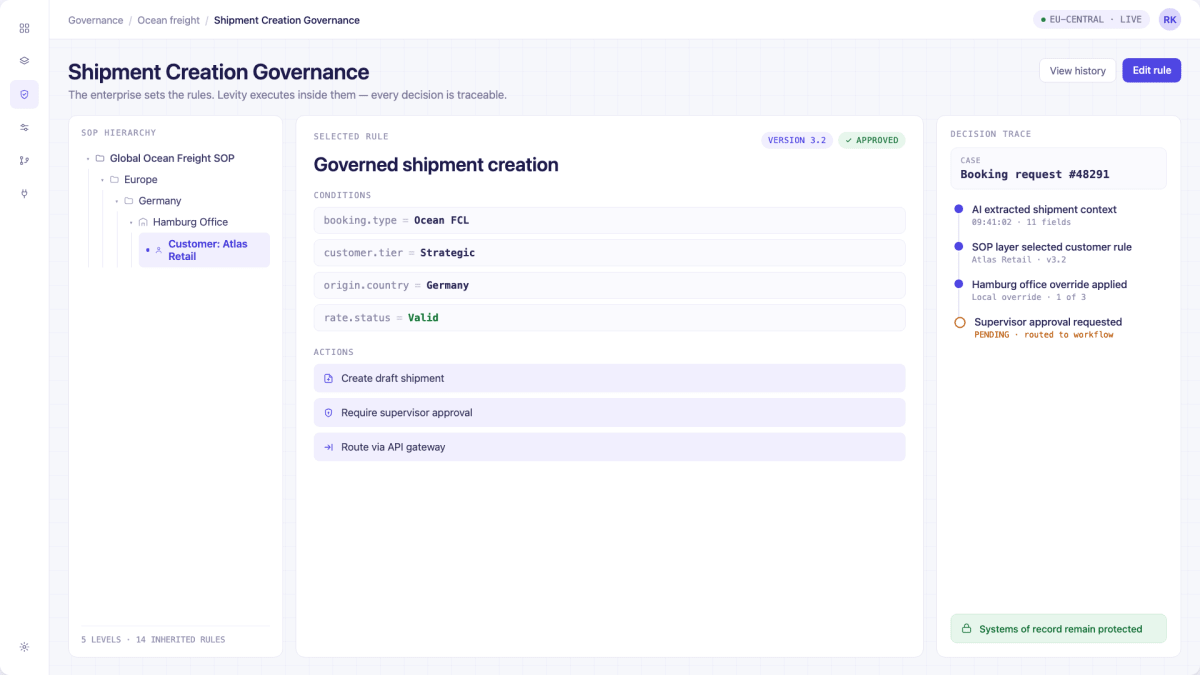
Your enterprise owns the rules. You know what constitutes an urgent issue, which team handles which type of request, and what information is needed to solve a problem. Your standard operating procedures are the source of truth.
Levity provides the Communication Intelligence to make those rules operational. It reads the chaotic, unstructured communication your TMS and ERP can't, understands it using AI models trained on the language of logistics, and runs the workflows your team controls.

Levity connects to your inboxes, classifies each incoming request based on your business logic, and extracts the necessary data. Your team no longer starts with a blank email. They start with a structured, pre-processed task, ready for action. Your leaders no longer rely on anecdotes. They get a clear, data-backed view of where the process is breaking down.
Don’t let your most valuable operational data disappear into the noise of daily fire-fighting. Rewire your operations to listen, and turn that flood of feedback into your single greatest asset for improvement.
Continue reading
All posts


Experience Levity in action
Explore how large logistics teams move from visibility to reliable automation — all in one platform.